
HEALTH INNOVATION
Open Source vs. Closed Source RIS: Choosing the Backbone of Radiology
Published on March 21, 2026
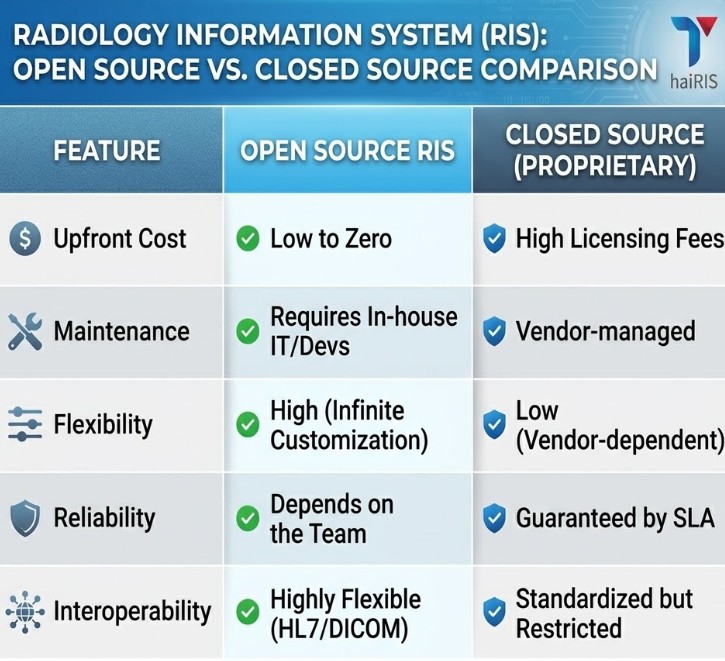
In the digital transformation of radiology, the choice between Open Source and Closed Source (Proprietary) Radiology Information Systems (RIS) is a pivotal decision. Both models offer distinct paths toward achieving a paperless workflow, but they differ significantly in cost, control, and continuity.
1. Open Source RIS: The Power of Customization
Open source systems (like dcm4chee or specialized frameworks) provide the source code to the public, allowing developers to modify and distribute the software.
Cost Efficiency: There are no "per-seat" or "per-site" licensing fees. This significantly lowers the barrier to entry for smaller clinics or developing regions.
Total Control: You own the system. If you want to integrate a specific Thai-language reporting tool or a custom billing module, you can build it without waiting for a vendor's roadmap.
Community Support: You benefit from a global pool of developers who constantly find bugs and create patches.
Transparency: There are no "hidden" features or proprietary data formats, making DICOM and HL7 integration more straightforward.
2. Closed Source RIS: The Security of Service
Proprietary systems (like those from Philips, GE, or Sectra) are "black boxes" where the vendor owns the code and provides it as a finished product.
Turnkey Solution: These systems are ready to use out of the box with standardized workflows based on global best practices.
Guaranteed Support: When the system goes down, you have a Service Level Agreement (SLA). A dedicated support team is legally obligated to fix the issue.
Regulatory Compliance: Large vendors invest heavily in ensuring their software meets strict international standards (like HIPAA, GDPR, or CE marking).
Seamless Integration: Proprietary RIS usually comes bundled with a matching PACS, providing a highly polished, unified user experience.
The Verdict
The choice depends on the human capital available. An Open Source RIS is ideal for organizations with strong internal IT teams who want to build a tailored ecosystem. A Closed Source RIS is better for institutions that prefer to outsource technical risks to a professional vendor in exchange for a stable, "worry-free" environment.
Image Generation Prompts (HD)
Option 1: The Open Source Concept (Digital/Collaborative)
"A high-definition conceptual 3D render. A glowing 'Open Source' symbol made of neon circuit lines in the center of a medical lab. Various floating digital modules representing 'Scheduling', 'Reporting', and 'Billing' are being plugged into a central RIS core by transparent robotic hands. 8k resolution, vibrant cyan and green lighting, futuristic tech aesthetic."
Option 2: The Proprietary 'Black Box' (Sleek/Corporate)
"A photorealistic shot of a high-end corporate data center. A sleek, matte black server rack with a glowing silver 'Enterprise RIS' logo. A professional technician in a branded uniform is monitoring the system on a high-tech tablet. Professional lighting, shallow depth of field, 8K, premium corporate atmosphere."
Option 3: The Comparison (Split Screen/Infographic style)
"A split-screen 3D visualization. On the left: a bright, collaborative workshop with developers coding a transparent RIS interface (Open Source). On the right: a polished, high-end private hospital suite with a perfectly integrated workstation (Closed Source). Contrast between 'DIY Innovation' and 'Premium Service'. 4k, hyper-detailed, clean composition."