
HEALTH INNOVATION
The Open Source Revolution in Medical Imaging: Exploring Open PACS
Published on March 21, 2026
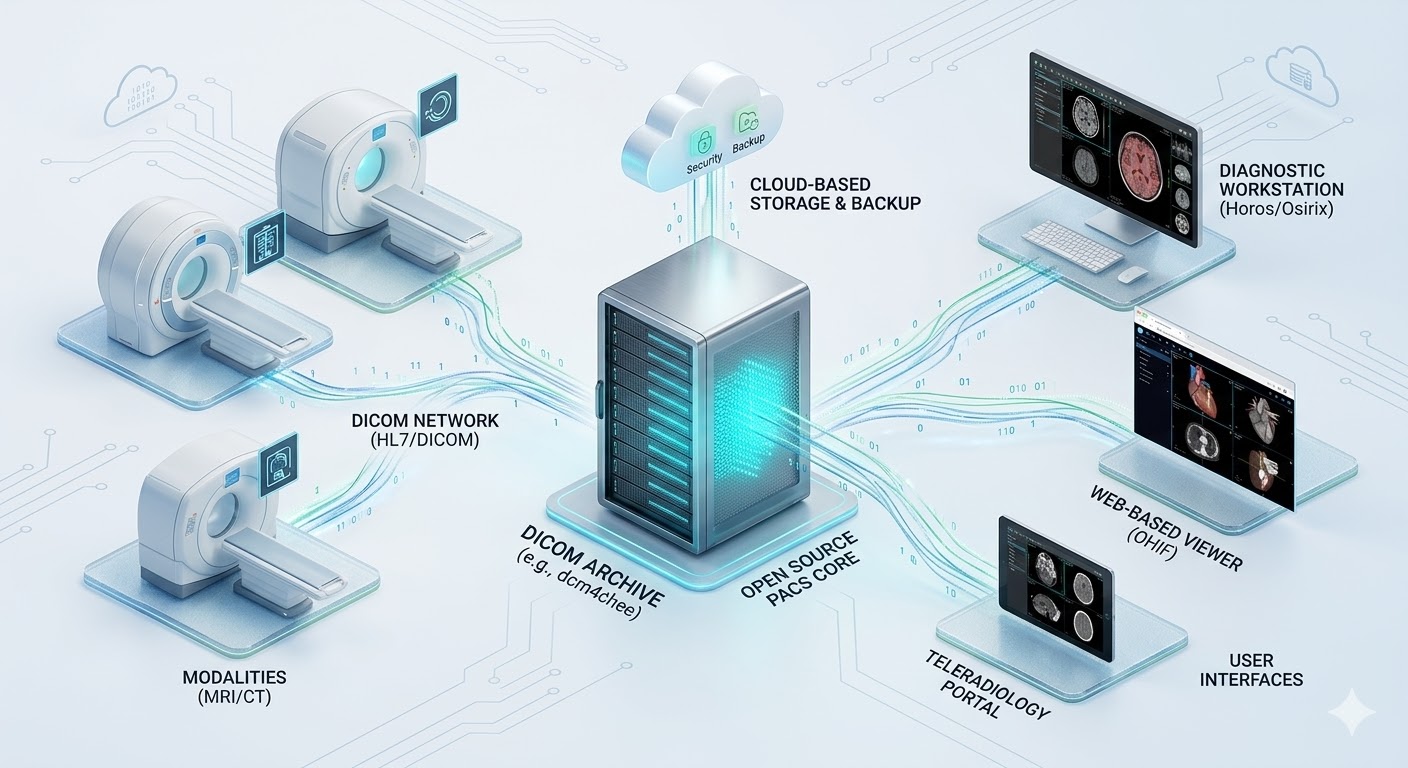
In the world of medical informatics, the PACS (Picture Archiving and Communication System) is the digital vault where life-saving images—DICOM files from X-rays, CTs, and MRIs—are stored, retrieved, and distributed. While proprietary "Big Tech" PACS solutions have long dominated the market, Open Source PACS has emerged as a powerful, transparent, and cost-effective alternative for hospitals and clinics worldwide.
What is Open Source PACS?
Open Source PACS refers to medical imaging software where the source code is available for anyone to inspect, modify, and enhance. Unlike closed-source systems, it relies on global standards—primarily DICOM (Digital Imaging and Communications in Medicine) and HL7 (Health Level Seven)—to ensure it can communicate with any medical device or Hospital Information System (HIS).
The Core Components
A complete Open Source PACS ecosystem typically consists of four main parts:
The Archive (The Server): Where images are stored (e.g., dcm4chee).
The Database: Manages the metadata and patient information (often using SQL like PostgreSQL).
The Web Viewer: Allows doctors to see images in a browser (e.g., OHIF Viewer).
The Diagnostic Workstation: High-end software for radiologists to manipulate 3D images (e.g., Horos or Osirix).
Key Advantages
Zero Licensing Fees: The most immediate benefit is the elimination of "per-modality" or "per-user" costs. This allows facilities to reallocate their budget toward better hardware or more staff.
No Vendor Lock-in: You are not tied to a single company's roadmap. If a vendor stops supporting a product, you still own the code and your data remains in a standard, accessible format.
Total Customization: Developers can build specific tools tailored to a clinic's needs—such as custom AI integrations or specialized hanging protocols.
Security Through Transparency: Because the code is open, a global community of developers can find and patch security vulnerabilities much faster than a single company's internal team.
Leading Open Source PACS Solutions
dcm4chee: Often considered the "Gold Standard" of open-source clinical archives. It is a robust, Java-based server that can handle millions of images with high reliability.
Orthanc: A lightweight, RESTful PACS server known for its "plug-and-play" simplicity and ease of integration with web applications.
OHIF Framework: A modern, web-based DICOM viewer that works in any browser without requiring local installation, making it perfect for Teleradiology.
Horos / Osirix (Lite): Popular open-source viewers for Mac users that provide powerful 3D post-processing capabilities.
Challenges to Consider
While the software is free, implementation is not "free of effort."
Technical Expertise: You need a skilled IT team (like the one behind ThaiRIS) to set up, secure, and maintain the servers.
Hardware Costs: You still need to invest in high-quality storage servers and backup systems.
Responsibility: Without a vendor SLA, the responsibility for uptime rests entirely on the institution's internal or partner IT team.
Image Generation Prompts (HD)
Option 1: The Open Source PACS Architecture (Technical/Clean)
"A high-definition 3D infographic of an Open Source PACS server. In the center, a glowing blue server rack labeled 'DICOM Archive'. Lines of light connect it to an MRI machine, a Cloud icon, and a radiologist's laptop. Clean white background, minimalist 3D style, professional medical tech colors."
Option 2: The Modern Web Viewer (UI/UX Focus)
"A photorealistic close-up of a high-end medical monitor. On the screen is a dark-themed, sophisticated DICOM web viewer (like OHIF) showing a multi-planar reconstruction (MPR) of a human heart. The interface is sleek with orange and cyan accents. 8K, cinematic lighting, shallow depth of field."