
GLOBAL PROJECTS
The Power of Open Source: Customizing ThaiRIS to Your Vision
Published on March 24, 2026
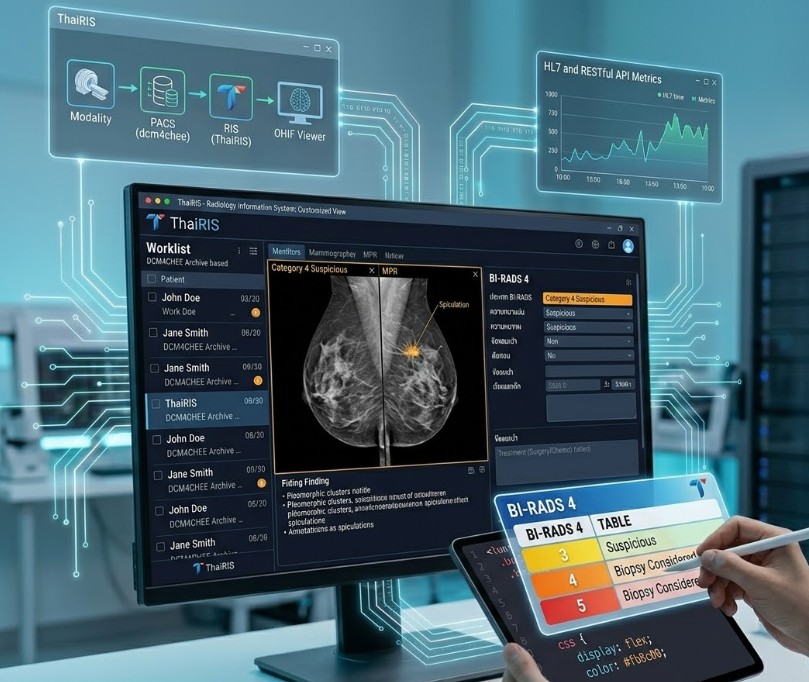
In the traditional world of medical software, the User Interface (UI) is often a "black box." Hospitals are forced to adapt their workflows to the software’s rigid design. ThaiRIS flips this narrative. Because ThaiRIS is built on an Open Source foundation, it offers an unprecedented level of UI flexibility, allowing healthcare providers to mold the system to their specific needs.
1. Why UI Customization Matters in Radiology
A radiology department is a fast-paced environment where every second counts. A cluttered interface leads to "click fatigue" and potential data entry errors. Customizing the UI is not just about aesthetics; it is about:
Operational Efficiency: Removing unused buttons and highlighting critical fields.
Reduced Training Time: Creating an intuitive layout that matches local hospital culture.
Role-Based Focus: Designing different views for receptionists, technologists, and radiologists.
2. The Open Source Advantage: No Permission Needed
With proprietary (Closed Source) systems, requesting a simple button change or a color adjustment can take months of vendor negotiation and significant costs. With ThaiRIS, the source code is yours to modify.
Front-End Freedom: Developers can use modern web technologies (HTML5, CSS3, JavaScript) to overhaul the look and feel.
Workflow Mapping: You can reorder steps in the patient registration process to match your physical desk layout.
Branding & Identity: Easily integrate your hospital’s branding, logos, and color schemes to create a professional, unified corporate identity.
3. From "Standard" to "Simple UI"
The recent evolution of the ThaiRIS Simple UI is the perfect example of this flexibility. By stripping away non-essential elements and focusing on a high-contrast, card-based design, the system has become faster and more user-friendly. This transition was only possible because the Open Source architecture allows for deep structural UI changes without breaking the core DICOM/HL7 logic.
4. Community-Driven Innovation
When one institution creates a better UI layout for a specific task—such as a specialized Teleradiology portal—the entire ThaiRIS community can benefit. This collaborative spirit ensures that the UI is constantly evolving based on real-world feedback from the people who actually use it every day.
KEY CUSTOMIZATION CAPABILITIES
Feature Customization Potential
───────────────────────────────────────────────
Dashboard Rearrange widgets, statistics, and worklists.
Reporting Templates Create specialized layouts for X-ray, CT, MRI, and Ultrasound.
Color Schemes Switch between Light, Dark, or High-Contrast modes for different lighting.
Language Fully localize the interface into any language (Thai, English, etc.).
Form Fields Add or remove patient data fields to comply with local regulations.