
HEALTH INNOVATION
Understanding BI-RADS: The Universal Language of Breast Imaging
Published on March 24, 2026
In radiology, the Breast Imaging-Reporting and Data System (BI-RADS) is a quality assurance tool designed to standardize breast imaging reporting. Developed by the American College of Radiology (ACR), it provides a uniform vocabulary and a structured scoring system that reduces confusion in breast cancer screening and diagnosis.
Why is BI-RADS Important?
Before BI-RADS, radiologists used varied terminology to describe findings, which could lead to misinterpretation by referring physicians. BI-RADS solves this by providing:
Standardized Terminology (Lexicon): Specific words to describe calcifications, masses, and breast density.
A Clear Assessment Structure: A numerical score that indicates the level of suspicion.
Actionable Recommendations: Every score comes with a specific "Next Step" for patient care.
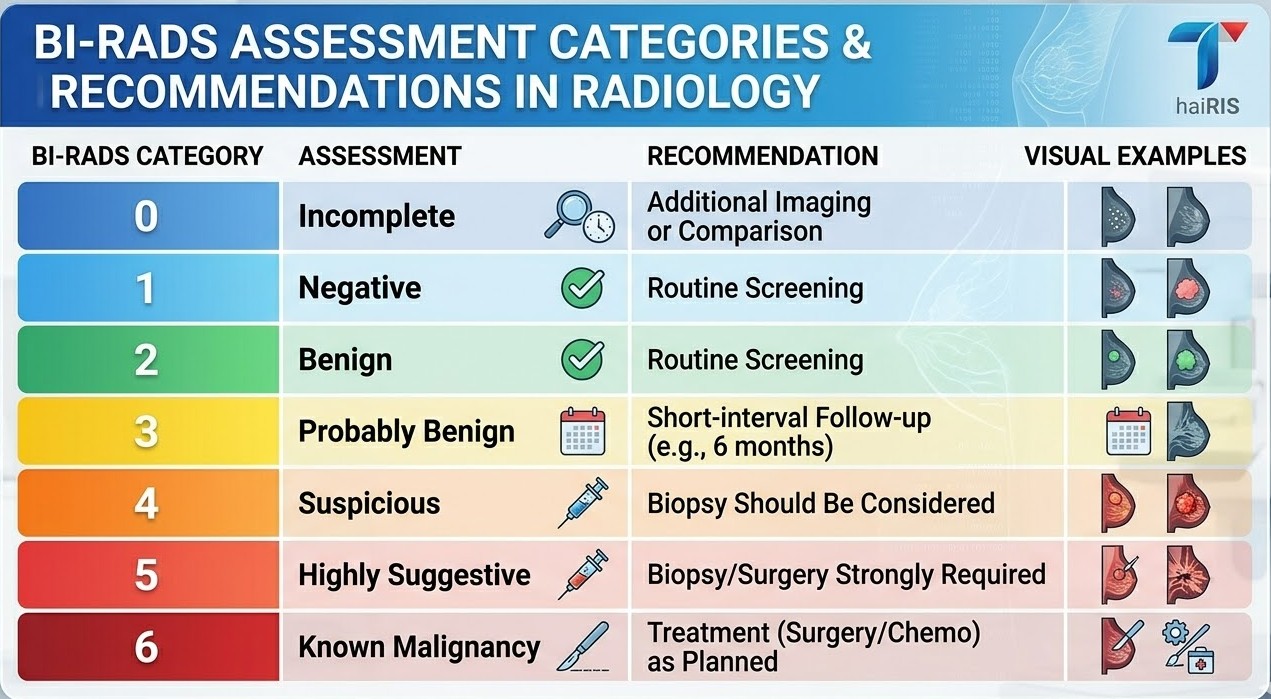
The BI-RADS Assessment Categories
The system categorizes findings into seven distinct levels, ranging from 0 to 6.
See in Photo
BI-RADS and Breast Density
In addition to the numerical score, a BI-RADS report also classifies Breast Density. This is crucial because dense breast tissue can sometimes "mask" or hide small tumors on a mammogram.
Category A: Almost entirely fatty.
Category B: Scattered areas of fibroglandular density.
Category C: Heterogeneously dense (may obscure small masses).
Category D: Extremely dense (lowers the sensitivity of mammography).
Integration with RIS and PACS
For systems like ThaiRIS, BI-RADS integration is essential. A modern Radiology Information System (RIS) uses BI-RADS tracking to:
Automate Follow-ups: Automatically flag BI-RADS 3 cases for 6-month recalls.
Audit Performance: Track the "Positive Predictive Value" (PPV) of the department's findings.
Standardize Reporting: Use pre-defined templates that force a BI-RADS conclusion before the report can be signed.